
After years of working alongside sugarcane farmers and small jaggery makers, I learned that the real difference between organic jaggery and normal jaggery begins long before the cane is crushed.
Organic jaggery is the result of chemical-free farming and slow, traditional processing that preserves the plant’s natural nutrition. Normal jaggery, on the other hand, is often produced from conventionally grown cane and chemically clarified juice, which affects its purity, taste, and nutrient composition.
This article explores each stage of that journey: farming, processing, nutrition, appearance, certification, and health, so you can understand how every choice in production shapes the sweetness on your plate.
Farming
Organic jaggery starts in a living soil system. Farmers avoid synthetic fertilizers, pesticides, and genetically modified seeds, relying instead on compost, green manure, and crop rotation.
This improves microbial balance and allows sugarcane to draw more iron, magnesium, and potassium from the soil. The result is juice rich in trace minerals and free from chemical residues.
Conventional sugarcane fields used for normal jaggery often depend on chemical growth boosters and pest control agents to increase yield. Though efficient, these inputs degrade soil structure and introduce pesticide residues that can pass into the extracted juice.
Over years of observation, I found organic farms not only produce cleaner cane but also consume less water and maintain higher soil carbon, the foundation of natural sweetness.
Processing
The biggest divergence appears once the juice is extracted. In traditional organic units, clarification happens through natural coagulants like okra or banana stem extract.
These plant agents lift impurities gently without stripping away molasses, the dark, mineral-rich component that gives jaggery its depth.
Boiling occurs in iron pans over controlled wood fires, which concentrate the juice gradually and preserve its nutrient complexity.
Normal jaggery processing replaces this slow clarification with lime or sulphur dioxide, which acts quickly but chemically alters the juice. Industrial pans operating at high temperatures accelerate evaporation, producing more volume but reducing mineral integrity.
Having watched both methods, I can confirm that organic jaggery’s slower boil retains its earthy aroma and authentic sweetness, while normal jaggery gains uniform color at the cost of nutritional subtlety.
Nutritional Profile
Organic jaggery retains a fuller micronutrient spectrum because its minerals remain bound to natural molasses.
It provides measurable amounts of iron, calcium, potassium, and antioxidants, all contributing to better metabolism and stable energy release. It’s low chemical exposure ensures these nutrients reach the body in bioavailable form.
Normal jaggery still offers calories and some iron, but loses part of its antioxidant capacity during chemical clarification.
The use of sulphur compounds or excess heat often reduces vitamin and mineral retention, making it less beneficial over long-term consumption.
Laboratory studies show organic jaggery contains higher polyphenol levels and less trace contamination, aligning with what traditional Ayurvedic texts described centuries ago as “pure gud.”
Appearance and Taste
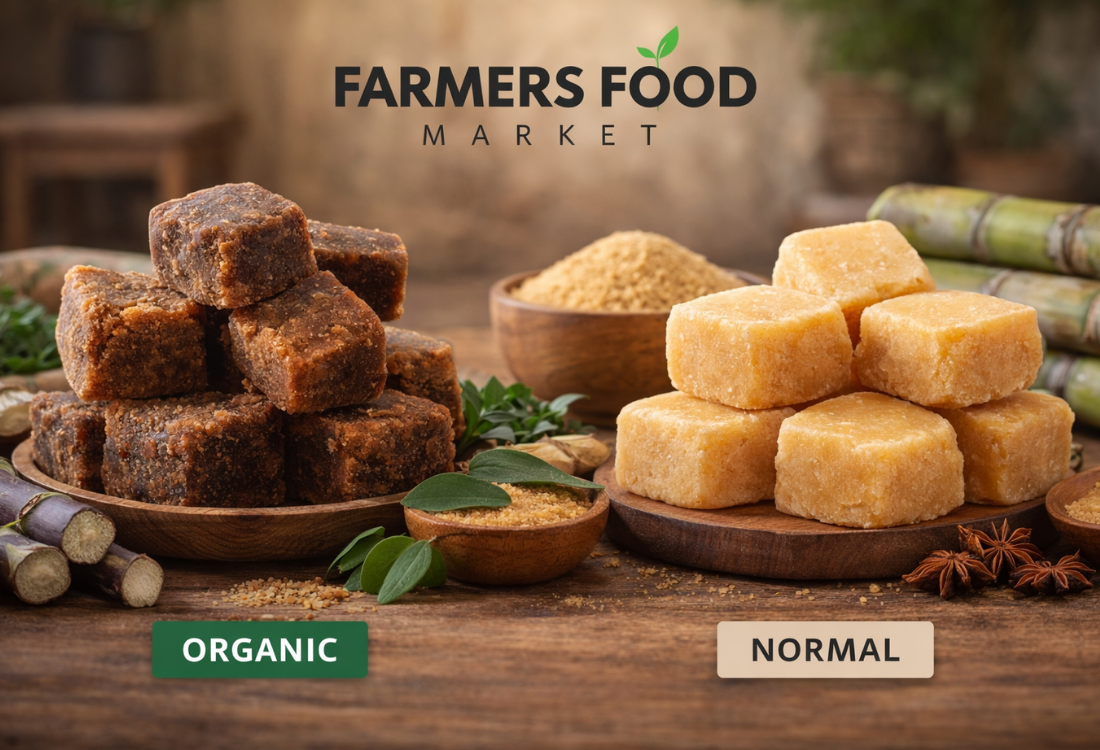
Visual and sensory cues tell an honest story. Organic jaggery appears darker, sometimes uneven in tone, and slightly coarse in texture.
These characteristics signal the presence of unrefined molasses and natural crystallization. Its flavor profile is complex, a mix of caramel, smoke, and cane nectar shaped by slow reduction in iron pans.
Normal jaggery tends to be light golden and smooth because chemical clarifiers bleach the color and remove molasses. The sweetness feels sharper but simpler, lacking the layered aroma of traditionally cooked cane.
When tasted side by side, organic jaggery leaves a lingering richness that reflects the soil it came from, while normal jaggery feels cleaner yet more neutral.
Each appeals to different preferences, but only the former preserves the authentic sensory link between farm and flavor.
Certification
Authentic organic jaggery carries recognized seals such as India Organic, USDA Organic, or ECOCERT. These verify that every step from soil preparation to packaging follows chemical-free standards and transparent traceability.
Certification bodies test for residue levels, microbial safety, and process compliance, ensuring that what reaches you truly qualifies as organic.
Normal jaggery sold in local markets often lacks such verification. Some may still follow semi-traditional methods, but without certification, there’s no assurance of consistent purity.
Certified organic jaggery gives consumers confidence that they are supporting sustainable cultivation and ethical processing, not just paying for a label.
The certification framework essentially connects farmers, regulators, and buyers in one trustworthy chain.
Health Benefits
From personal use and observation, organic jaggery offers noticeable physiological advantages. It helps replenish hemoglobin, aids digestion, and supports detoxification thanks to its natural iron and antioxidant compounds.
The absence of sulphur or lime residues prevents digestive irritation, making it suitable for children and people sensitive to processed sugars.
Because its carbohydrates are unrefined, organic jaggery provides steady energy release without sharp spikes.
Ayurveda regards it as a rasayana, a restorative food that balances internal heat and strengthens immunity. These effects arise from the synergistic presence of minerals, not from mere sweetness.
Normal jaggery, while still healthier than refined sugar, lacks that restorative quality once its molasses is stripped away. It functions primarily as a sweetener, not a nutrient source.
That difference defines why traditional households still prefer organic gud for herbal tonics, winter sweets, and post-meal digestion.
Conclusion
The journey from field to block reveals how purity, not polish, defines quality. Organic jaggery represents a chemical-free cycle cultivated in living soil, clarified with plant extracts, and concentrated without losing minerals.
Normal jaggery fulfills industrial demand but often sacrifices nutritional and environmental integrity.
Choosing organic jaggery supports farmers who preserve soil health, ensures cleaner nutrition for your family, and sustains the traditional craftsmanship behind this ancient food.
If you want to experience that authentic sweetness, consider sourcing your next batch from Farmers Food Market, where verified producers follow genuine organic standards.
The taste, aroma, and texture will remind you that true jaggery isn’t made in haste; it’s grown with care.




 Home
Home  Whishlist
  Compare
  Checkout
  Account