
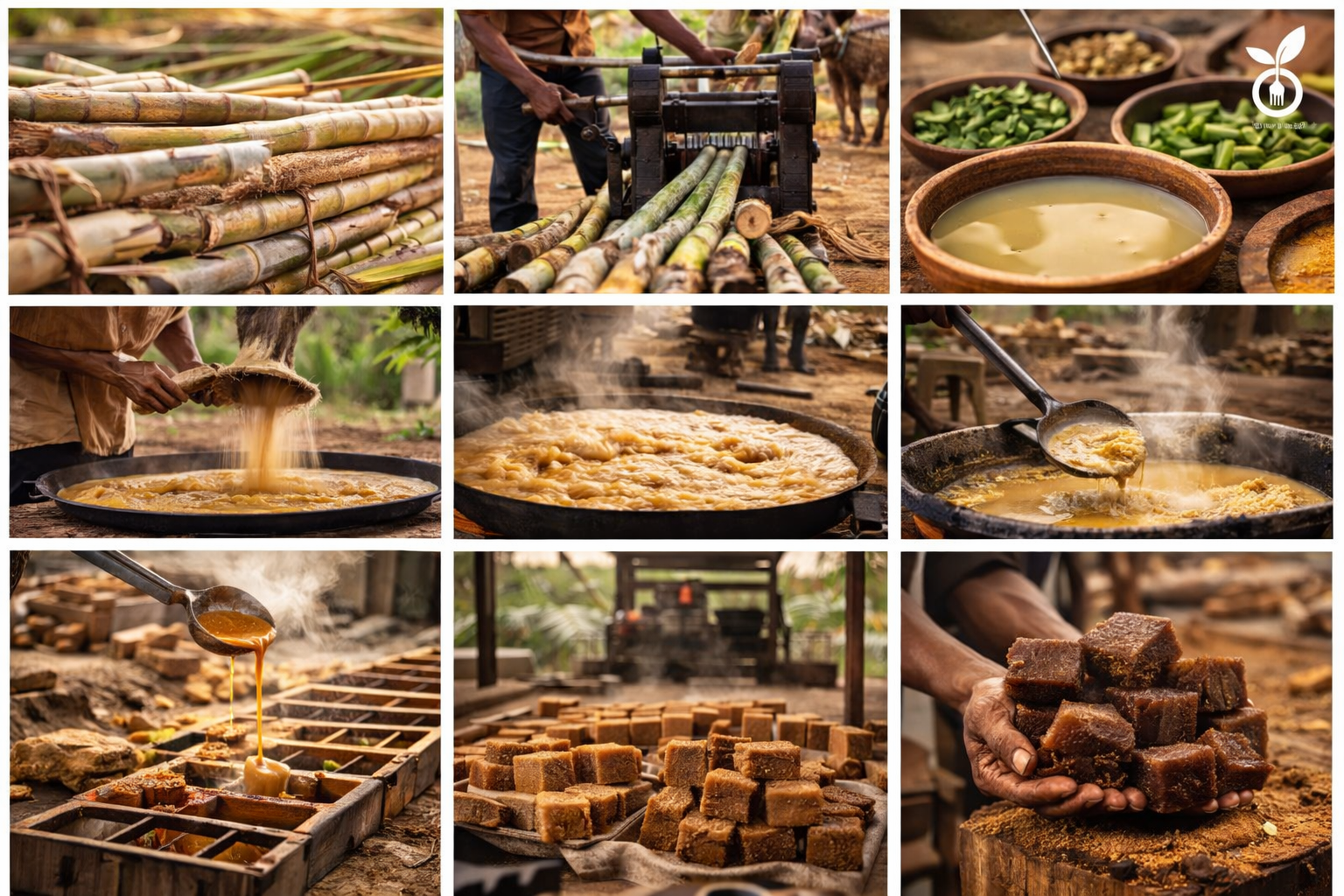
When I first started learning how organic jaggery is made, I was surprised by how much tradition, patience, and science go into it. Unlike refined sugar, which loses most of its natural goodness, organic jaggery preserves the nutrients and essence of freshly crushed sugarcane.
It begins right from organically cultivated sugarcane, grown without synthetic fertilizers or pesticides, and ends with a block of pure, earthy sweetness that still carries the aroma of the field it came from.
In this guide, I’ll walk you through exactly how organic jaggery is made step by step using traditional but certified organic methods that avoid any chemical clarifiers or artificial agents.
You’ll also understand how each stage, from harvesting to storage, affects its nutritional profile, purity, and quality.
What is Organic Jaggery?
Organic jaggery is a natural, unrefined sweetener made by concentrating organic sugarcane juice without using chemicals, sulphur, or bleaching agents. The main difference between organic and regular jaggery lies not only in the way it looks or tastes but in how it’s produced.
Organic jaggery is prepared using slow-boiling and natural clarification techniques that preserve its minerals like iron, magnesium, and calcium. It also retains antioxidants that get destroyed in sulphured jaggery.
Because no chemicals are used, it has a deeper caramel tone, a stronger aroma, and a mild molasses-like sweetness.
In short, organic jaggery is sugarcane juice transformed naturally without additives into a wholesome food rich in nutrients and taste.
9 Steps to Make Organic Jaggery
When you see a golden-brown block of organic jaggery in the market, it might look simple. But behind it lies a 9-step journey involving precision, timing, and sustainable techniques that define its quality and purity.
Let’s look at each stage in the organic jaggery-making process and understand how it adds value to this nutrient-dense traditional sweetener.
Step 1: Harvesting
The process begins with harvesting organically grown sugarcane, typically after 12 to 14 months of growth. The maturity of the cane is critical because the sucrose content peaks during this period, directly influencing the sweetness and texture of the final jaggery.
Farmers avoid using chemical fertilizers or pesticides; instead, they rely on natural compost and bio-fertilizers. This organic soil management not only enhances the taste but also increases micronutrients in the juice. Healthy soil produces sweeter cane, and sweeter cane means nutrient-rich organic jaggery.
Step 2: Extraction of Juice
Freshly harvested cane is crushed within a few hours to retain its natural nutrients and avoid oxidation. Organic jaggery makers use stainless-steel crushers that prevent contamination from grease or rust, a common issue in traditional iron mills.
The juice that flows out is filtered through fine cloth or mesh to remove debris. No chemical decolorizers or bleaching agents are used. This pure extraction step preserves the natural greenish-brown tint and authentic flavor of the juice — the base for high-quality organic jaggery.
Step 3: Settling
Once the juice is extracted, it is allowed to settle naturally for several hours. During this time, heavy particles like fibers or soil residue sink to the bottom. The upper layer becomes clean, translucent liquid, ready for clarification.
This sedimentation process is entirely natural, requiring no external agents. It helps retain essential minerals while separating impurities gently. In my own experience, this step determines whether your jaggery will stay shelf-stable and bright in color or turn dark and sticky later.
Step 4: Clarification
Clarification is the most delicate part of making organic jaggery. Here, the naturally settled sugarcane juice is gently heated, and impurities are removed using plant-based clarifiers like okra extract, hibiscus leaves, or wild herbs. Unlike conventional jaggery, which often uses lime or phosphoric acid, organic production avoids synthetic additives altogether.
These botanical clarifiers cause suspended particles and proteins to coagulate, which rise to the surface as scum. It’s carefully skimmed off using wooden ladles, leaving behind clean, nutrient-rich juice.
This natural clarification step ensures that the final product remains free from chemical residues. Studies have shown that such organic clarification methods help retain up to 25% more iron and calcium compared to sulphured jaggery, while maintaining a clean, amber tone and superior taste.
Step 5: Concentration
After clarification, the filtered juice moves to large, shallow pans or karahis, traditionally heated using bagasse the fibrous by-product of crushed sugarcane. Bagasse serves as a sustainable fuel, reducing waste and lowering carbon footprint.
The juice is boiled slowly at temperatures between 110°C and 120°C, continuously stirred to prevent caramel burning.
During this stage, the liquid thickens and deepens in color as moisture evaporates. The aroma changes from grassy to warm and nutty. Skilled artisans use sensory cues smell, texture, and bubble consistency to determine when it’s ready.
Unlike industrial sugar processing, which uses high heat and chemical bleaching, this slow boiling preserves the jaggery’s antioxidant compounds and natural molasses, which carry trace minerals and vitamins that make it a healthier sweetener.
Step 6: Cooling
Once the syrup reaches a semi-solid, viscous stage, it’s transferred to large cooling trays. This process must happen quickly and under hygienic, dust-free environments to prevent crystallization issues. Cooling helps the mixture stabilize, achieving a uniform consistency and preventing nutrient degradation.
Properly cooled jaggery retains its glossy texture and moisture balance. In my own practice, I’ve noticed that careful cooling directly influences both the shelf life and granulation—overcooling causes brittleness, while uneven cooling leaves soft pockets that ferment over time.
Step 7: Moulding
The cooled mass is then poured into wooden or stainless-steel moulds, shaped into blocks, discs, or cones. These moulds are cleaned with organic sanitizers like neem water to maintain food-grade safety. The material solidifies naturally as it cools further, forming the dense, nutrient-rich texture jaggery is known for.
This stage defines the jaggery’s color uniformity and texture. Smooth moulding creates compact blocks that store longer without moisture absorption. No artificial hardeners or preservatives are used; instead, the natural viscosity of concentrated sugarcane juice gives it strength and body.
Step 8: Packaging
Once solidified, the organic jaggery blocks are ready for packaging. Unlike commercial jaggery that may be wrapped in plastic or stored loosely, organic producers use biodegradable, food-grade paper or vacuum-sealed pouches to maintain purity.
The packaging process is conducted in humidity-controlled areas to prevent moisture absorption, which can lead to microbial growth or fermentation.
Organic certification standards require strict handling protocols to ensure no cross-contamination with non-organic products. Clean stainless-steel tables, temperature-controlled storage, and recyclable wraps make the packaging both hygienic and sustainable.
This step plays a bigger role than most people realize. Proper packaging preserves the jaggery’s natural aroma, mineral content, and soft crystalline texture, ensuring it reaches consumers as pure and nutrient-rich as it was when made.
Step 9: Storage
The final step is storage. Organic jaggery must be stored in cool, dry, and dark conditions to maintain its freshness and prevent sugar bloom or stickiness. Producers often use climate-regulated storage units or naturally ventilated rooms lined with organic materials like bamboo mats or neem leaves that repel moisture and insects.
No preservatives are used. Instead, natural anti-microbial measures, such as maintaining low humidity and airflow, keep the jaggery safe for several months. The result is a product that remains chemical-free, nutritionally intact, and true to its origin.
When I’ve stored my own batches this way, I’ve noticed how well the flavor matures over time — becoming even richer and more caramel-like, much like aged honey or maple syrup.
Conclusion
Organic jaggery is made through a careful nine-step process that includes harvesting, extraction, settling, clarification, concentration, cooling, moulding, packaging, and storage. Each stage protects its natural nutrients, avoids chemicals, and upholds the principles of sustainable, traditional craftsmanship.
From the moment the sugarcane is crushed to the final packaging, organic jaggery remains untouched by synthetic substances, making it a truly farm-to-table sweetener that supports both health and the environment.
If you’ve never tried it before, I’d strongly encourage you to buy authentic organic jaggery from trusted producers at the Farmers Food Market. You’ll experience not only a richer taste but also the peace of mind that comes from knowing your food is pure, chemical-free, and ethically made.




 Home
Home  Whishlist
  Compare
  Checkout
  Account